Mobile vehicle barriers - certified, modular, ready to deploy
The BLOCKSTAHL flagship FSB E600 stops a 7.5-t truck at 48 km/h within 18.6 m - stopped in the displacement test after just 3.3 m, impact test at 48 km/h within 18.6 m, tamper class MK2, certified to ISO 22343-1:2023, performance rating V/7200[N2A]/48/90:18.6/11.2 and DIN SPEC 91414-1:2021 with 649 kJ. This makes it the most requested system for anti-terror protection, critical infrastructure and truck-capable access points.
The complementary FSB M300 covers SUV threat scenarios with a vehicle stop within 8 m (ISO 22343-1, protection class N1G). Both systems are mobile, modular, deployable without a foundation and developed and built in Germany.
Cities, municipalities, event organisers and operators of critical infrastructure get a solution that deploys within minutes without heavy equipment and adapts flexibly to different threat scenarios. We deliver, install and handle the full project from the first consultation to on-site acceptance.
Vehicle barrier, access barrier, roadblocker - many names, one purpose
Depending on industry, authority or application, many terms are used for mobile vehicle barriers. A quick orientation:
- Mobile vehicle barrier / vehicle security barrier - the technical umbrella term. Describes the certified system that physically stops a vehicle on impact.
- Access barrier / through-traffic barrier / vehicle access protection - the municipal terms. They emphasise the function: closing a street, square or event area to vehicle traffic.
- Roadblocker - the international term, often used in tenders and English-language security concepts.
- Mobile truck barrier - the variant for heavy vehicles. This is where our FSB E600 comes in, stopping a 7.5-t truck at 48 km/h within 18.6 m.
- Anti-terror barrier / counter-terror protection - the term in the context of Hostile Vehicle Mitigation (HVM) and police anti-terror concepts.
- Perimeter protection with mobile barriers - the term in critical infrastructure. A ring-shaped deployment around a site or facility.
All terms ultimately describe the same protection goal: reliably stop vehicles before they reach people or facilities. BLOCKSTAHL provides the right system for every one of these applications.
Which vehicle barrier suits which deployment?
Before we look at the specifications of the BLOCKSTAHL systems, here's an orientation for the basic choice: the market offers four typical barrier types with very different strengths.
| System | Protection | Installation | Suitable for |
|---|---|---|---|
| Mobile vehicle barrier without foundation (BLOCKSTAHL FSB M300) | tested to DIN ISO 22343-1:2025 (N1G), stops SUV at 48 km/h within 8 m | set up in 4 min., no ground works | events, inner cities, heritage areas, temporary security zones |
| Retractable bollards | high breakthrough protection, high maintenance | foundation + hydraulics, permits required | permanent access points with controlled delivery/resident traffic |
| Fixed bollards | highest protection, no manipulation risk | concrete foundation + civil works required | government buildings, embassies, permanent protection points |
| Crowd-control fences | traffic guidance only, no breakthrough protection | fast set-up | traffic management, NOT suitable as anti-terror protection |
For events, temporary security zones and deployments in historic inner cities, mobile, foundation-free barriers have established themselves as the best solution - safe, flexible and with zero intervention in the ground cover. This is exactly the class BLOCKSTAHL products cover.
FSB E600 or FSB M300 - which system for which use case?
BLOCKSTAHL offers two protection classes covering different threat scenarios. The choice depends on the vehicle type and the expected impact speed at the location. The flagship and most requested system is the FSB E600.
| BLOCKSTAHL FSB E600 Flagship | BLOCKSTAHL FSB M300 | |
|---|---|---|
| Protection class (ISO 22343-1) | N2A - truck 7.5 t at 48 km/h | N1G - car up to approx. 2.5 t at 48 km/h |
| Stopping distance | vehicle stop within 18.6 m | vehicle stop within 8 m |
| Typical threat | heavy vehicle attack, truck ramming (Magdeburg scenario) | uncontrolled car entry, car attack |
| Recommended for | anti-terror protection, critical infrastructure, government buildings, high-risk scenarios, truck-capable access points | inner cities, 30 km/h zones, town festivals, Christmas markets, event security |
| Set-up and emergency clearance | no set-up time, emergency clearance in under 1 minute | set-up approx. 4 minutes per module, emergency clearance in under 1 minute |
| Ground anchoring | none | none |
| Made in Germany | yes, patented and licensed | yes, patented and licensed |
Unsure which system fits your situation? National police crime prevention authorities recommend a concrete threat analysis for every location. We support you with this - get in touch with us.
BLOCKSTAHL FSB E600 - the flagship for truck-capable access points
The FSB E600 is BLOCKSTAHL's most powerful mobile barrier system and the most requested model. It is tested to ISO 22343-1 in protection class N2A - designed for a 7.5-tonne truck at an impact speed of 48 km/h. This covers the scenarios that have come into sharper municipal focus since the Magdeburg attack in 2024/25.
| System designation | BLOCKSTAHL FSB E600 |
|---|---|
| Protection class | ISO 22343-1:2025, N2A (truck 7.5 t at 48 km/h) |
| Set-up / emergency clearance | no set-up time, emergency clearance in under 1 minute |
| Stopping distance | vehicle stop within 18.6 m |
| Ground anchoring | none - deployable without a foundation |
| Certification | ISO 22343-1:2025 |
| Patent status | patented and licensed |
| Origin | Made in Germany |
Because of its performance class, the FSB E600 is the preferred system for anti-terror protection, perimeter security at critical infrastructure and all access points that cannot be secured by car-only restrictions. Detailed specifications and crash-test data are available on the FSB E600 product page.
BLOCKSTAHL FSB M300 - the car-rated complementary system
The FSB M300 complements the flagship for car threat scenarios - typically inner-city festivals, 30 km/h zones and Christmas markets. It is tested to ISO 22343-1:2025 in protection class N1G (car at 48 km/h impact speed).
| System designation | BLOCKSTAHL FSB M300 |
|---|---|
| Protection class | ISO 22343-1:2025, N1G (car up to approx. 2.5 t at 48 km/h) |
| Set-up / emergency clearance | set-up approx. 4 minutes per module, emergency clearance in under 1 minute |
| Stopping distance | vehicle stop within < 8 m |
| Ground anchoring | none - deployable without a foundation |
| Certification | ISO 22343-1:2025 |
| Patent status | patented and licensed |
| Origin | Made in Germany |
Transport and logistics (both systems)
- Loading and unloading without crane or forklift
- Transport by car trailer or truck with tail lift
- Purpose-built rolling systems for easy on-site handling
- Optional: electric Mover M18 or FLEXIBLE-M electric pallet truck for effortless handling
What does the stopping distance (penetration) mean?
The stopping distance is the key figure of any vehicle barrier. It describes the distance within which the barrier brings a vehicle to a complete stop after impact. The FSB M300 stops a car at 48 km/h within 8 m, while the flagship FSB E600 stops a 7.5-t truck at 48 km/h within 18.6 m - in each case the protection zone behind the barrier remains intact.
This is measured in standardised crash tests according to ISO 22343-1:2025. The heavier and faster the vehicle, the longer the physically required stopping distance - the certified penetration always relates to the respective protection class and test vehicle. Both BLOCKSTAHL systems achieve certified values in their class and maintain the necessary safety margin to the crowd or facility being protected.
Use cases overview
Mobile vehicle barriers are needed wherever a temporary protection against vehicle access is required - without permanent interventions in public space. BLOCKSTAHL systems are deployed at Christmas markets and town festivals, in pedestrian zones and listed inner cities, at major events, concerts and sports events as well as for perimeter protection of critical infrastructure.
Specific use cases with requirements, authority recommendations and matching protection classes are described in detail in our use cases overview.
All from a single source: purchase, rental or full set-up service
We offer our vehicle access protection in three models to suit different requirements and budgets:
Purchase
For cities, municipalities and operators with regular needs. Buying our vehicle barriers is a long-term investment in security infrastructure. The system is reusable without limit and requires no consumables.
Rental
For one-off or seasonally recurring events. Renting our mobile road barriers enables certified protection without capital commitment. We handle timely delivery, set-up, dismantling and collection.
Set-up service
On request we take over the complete set-up and dismantling on site. Experienced technicians install the system according to the pre-agreed security concept. This service is particularly suitable for municipalities and event organisers without dedicated security personnel for the installation.
Certification and standards conformity
Both BLOCKSTAHL systems are tested to ISO 22343-1:2025 - the current international standard for vehicle security barriers. The FSB E600 meets protection class N2A (truck 7.5 t at 48 km/h, vehicle stop 18.6 m), the FSB M300 meets class N1G (car at 48 km/h, vehicle stop under 8 m). Both certifications confirm the stopping distance under the defined test conditions.
For event organisers and authorities this means: using BLOCKSTAHL barriers supports the fulfilment of regulatory requirements and security concepts. All required certification documents are provided with delivery. Download the certificates as PDF.
Cost reduction through integrated advertising spaces
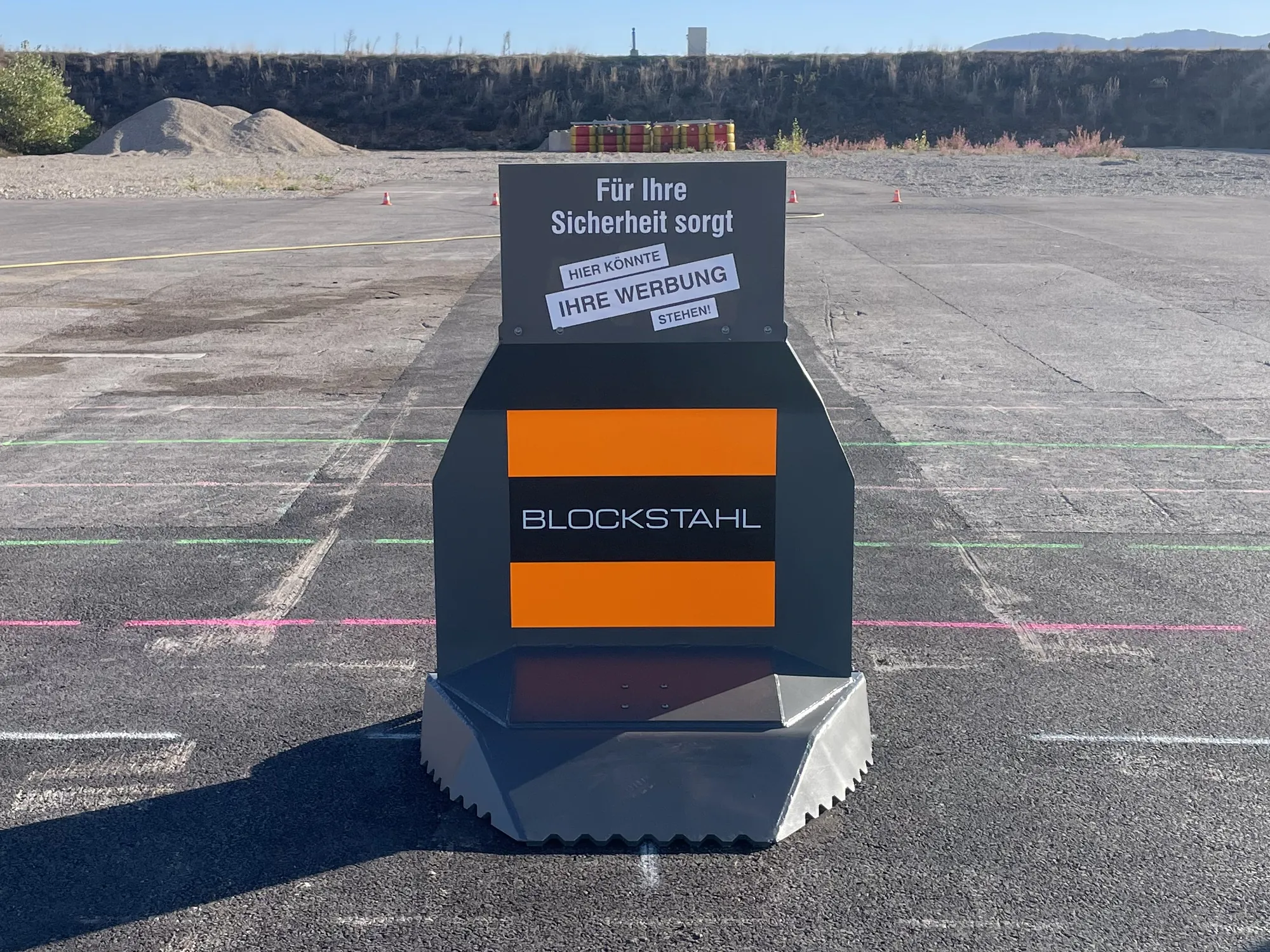
The FSB M300 features integrated advertising panels on every barrier. These can be used by sponsors or municipal partners to offset part of the acquisition or rental costs.
For cities and municipalities financing mobile vehicle barriers from public budgets, this model offers an economically attractive alternative to full self-financing.